शनिवार, 17 नवंबर 2018

Low-carb diets might be best for maintaining weight loss, study says

(CNN)The best way to maintain weight loss may be to change your diet to one low in carbohydrates, according to new research.
The study, published Wednesday in the journal BMJ, involved 164 overweight or obese people. Their weight was brought down by 12%, and they were stabilized at that weight and put on a high-, medium- or low-carbohydrate diet for 20 weeks.
The diets were made up of 20% carbs and protein and 60% fat, 40% carbs and fat and 20% protein, or 60% carbs and 20% protein and fat.
"We found that the type of diet people ate had a major impact on their metabolism. Those on the low-carbohydrate diet burned about 250 calories a day more than those on the high-carbohydrate diet, even though all the groups were the same weight," said Dr. David Ludwig, principal investigator of the study and co-director of the New Balance Foundation Obesity Prevention Center at Boston Children's Hospital.
While participants were on these diets, their calorie intake was controlled so that they maintained the baseline weight. If a participant started to lose or gain weight, their calorie intake was increased or decreased.


"If somebody's metabolism speeded up, they would have started losing weight, and that would have triggered us to increase calories just to restore weight to that baseline target," said Ludwig, who is also a professor of pediatrics and nutrition at Harvard University.
The research looked at diet's effect directly on the metabolism, he said, which is one of the things that works against you when you are trying to maintain weight.
"These findings show that all calories are not alike to the body from a metabolic perspective and that restricting carbohydrates may be a better strategy than restricting calories for long-term success," Ludwig said.
He also believes that, without the calorie control intervention, having a low-carb diet could create spontaneous weight loss of about 20 pounds over a few years.
"This seems like an important finding BUT I would be highly cautious as the interpretation of the results seems quite incorrect," said Naveed Sattar, professor of metabolic medicine at the University of Glasgow, in a written statement.
Get CNN Health's weekly newsletter
Sign up here to get The Results Are In with Dr. Sanjay Gupta every Tuesday from the CNN Health team.
Sattar, who was not involved with the study, said that the low-carbohydrate group seems to have been eating more calories than the other groups to have kept similar weights.
"This brings the other point that what really matters is weight change and we already know from much larger and longer trials that weight loss is broadly similar whatever diet one takes (low carb or low fat or others) as long as one sticks to the diet," he said.
"So, in short, I don't believe this work changes anything and nor does it convince me that low carb diets are meaningfully better to relevant health outcomes. The overwhelming evidence does not support this."
    Experts also pointed out that all the participants had the same basic metabolic rate, so other unmeasured activities could explain differences, as well as high levels of saturated fat in the low-carbohydrate diet, which could lead to increased cholesterol and heart disease risk.
    Kevin McConway, emeritus professor of applied statistics at the Open University, noted that "because the different diets had to be made up from foods that may have differed in other ways than just their carbohydrate and fat content, it remains possible that these other differences were responsible for some part of the observed differences in energy expenditures."

    मंगलवार, 13 नवंबर 2018

    राफेल का पूरा सच खोल डाला मेजर जनरल एस पी सिन्हा ने

    Major General Mrinal Suman, AVSM, VSM, PhD, commanded an Engineer Regiment on the Siachen Glacier, the most hostile battlefield in the world. A highly qualified officer (B Tech, MA (Public Administration), MSc (Defence Studies) and a Doctorate in Public Administration) he was also the Task Force Commander at Pokhran and was responsible for designing and sinking shafts for the nuclear tests of May 1998.

    बे -शक भारतीय प्रतिरक्षा सेवाओं के साथ -साथ भारतीय चुनाव आयोग और माननीय सुप्रीम कोर्ट का भारत को अन्य 
    राष्ट्रों के बीच एक अग्रणी राष्ट्र बनाये रखने उसकी सम्प्रभुता को अक्षुण रखने में अप्रतिम योगदान रहा आया है। 

    लेकिन जैसे -जैसे २०१९ नज़दीक आ रहा है उन लोगों की बे -चैनी बढ़ती जा रही है जो वर्तमान राजनीतिक प्रबंध में स्थान नहीं पा सके। इनमें चंद रक्तरँगी तो हैं ही, धंधेबाज़ राजनीतिक विपक्ष के संग -संग सुपर राजनीतिक की भूमिका में माननीय सुप्रीम कोर्ट भी आता दिखलाई दिया है। ऐसा हम नहीं कहते भारत -धर्मी समाज के लोग मुंह खोलकर कहने लगें हैं। 

    ऐसे ही चंद लोगों से हमने इस मुद्दे पे बात की है जिनमें भारत धर्मी समाज के प्रमुख ,चिंतक एवं विचारक मूर्धन्य साहित्यकार डॉ.नन्द लाल मेहता 'वागीश ' चंद प्रतिरक्षा से जुड़े लोग भी शरीक रहें हैं। बातचीत का लब्बोलुआब सार रूप में यहां प्रस्तुत है :
    केरल से बात शुरू की है इन तमाम लोगों ने जहां भारत को तोड़ने में मशगूल रहे आये वाम मार्गियों के इशारों पर अब सुप्रीम कोर्ट भी थिरकता नज़र आता है। 

    प्रसंग सबरीमाला और अयोध्या से भी जुड़ जाता है। परमात्मा ने औरतों और मर्दों को यकसां नहीं बनाया है। हमारे मनीषियों ने मन पर बड़ा अनुसंधान करने के बाद ही कुछ वैज्ञानिक नियम बनाये थे उनमें रजस्वला स्त्री को सबरीमाला जैसे पूजा ग्रहों में शुचिता के आधार पर प्रवेश की अनुमति नहीं दी गई थी। सनातन आस्था का यह प्रश्न है माननीय सुप्रीम कोर्ट ने एक झटके में लैंगिक बराबरी के नाम पर इस आस्था को तोड़ दिया। 

    खुदा से पूछना चाहिए सुप्रीम कोर्ट राम को तो वह मानता नहीं कि उसने औरत और मर्द की शारीरिक संरचना में इतना फर्क क्यों रखा ?क्यों मर्दों को मासिक स्राव की पीड़ा नहीं झेलनी पड़ती। क्यों महिलाओं को मूंछे नहीं हैं ?महिलाओं को इस दरमियान ( महीने के चंद मुश्किल दिनों में )शारीरिक और मानसिक विश्राम की जरूरत पड़ती है।इसे दरकिनार कर सुप्रीम कोर्ट ने एक झटके में जन -आस्था को पलीता लगा दिया। पूछा जा सकता है क्या सुप्रीम कोर्ट भी लेफ्टीयों में शामिल होकर सुपर लेफ्टीया बन गया है ?जिसके पास अयोध्या मामले पर विचार करने का वक्त इसलिए नहीं क्योंकि अयोध्या उसकी प्राथमिकताओं में नहीं हैं। 

    सबरीमाला कैसे आ गया आपकी प्राथमिकता में ?  

    दूसरा मुद्दा देश की प्रतिरक्षा से जुड़ा है। सेना के शौर्य को चुनौती देते हैं सुप्रीम कोर्ट के कुछ आदेश।जेहादियों का हौसला बढ़ाने वाला एक फैसला सुप्रीम कोर्ट  ने जुलाई २०१६ में यह दिया कि आमने सामने के मुकाबले में मारे गए हरेक आतंकी के खिलाफ शामिल सेनाधिकारी के खिलाफ प्राथमिकी दर्ज़ की जाए। घाटी के कितने इलाके आज देश की एकता को पलीता लगाने वाले चंद पाकितान सोच के लोगों के हाथों उत्पीड़न झेल रहे हैं पूरा देश इससे वाकिफ है। चंद मानवाधिकार वादियों को यह सब दिखलाई नहीं देता। उनकी आवाज़ देश की सुरक्षा से  बड़ी हो जाती है। सुप्रीम कोर्ट को वह आवाज़ दिल्ली बैठे बैठे सुनाई दे जाती है। सेना का इससे बड़ा अपमान  और क्या हो सकता है वह सेना जो देश के शौर्य का प्रतीक है, पूरी दुनिया जिसका लोहा मानती है सुप्रीम कोर्ट उसके हाथों में हथकड़ी पहनाने को आतुर लोगों  के साथ खड़ा दिखलाई देता है। 

    चंद सिरफिरे सत्ता गलियारों से बहिष्कृत लोग राफेल मामले में जो देश की प्रतिरक्षा से जुड़ा है सुप्रीम कोर्ट के दरवाज़े पर बे -वक्त पहुँचते हैं और माननीय कोर्ट उन्हें तरजीह देता है। जबकि राफेल के  महत्व को वायुसेना की  सर्वोच्च कमान  कबका देश के लिए एक  दम से ज़रूरी बतला चुकी है। 

    मेजर जर्नल मृणाल सुमन जी के इस महत्वपूर्ण विचार के हम भी पक्षधर हैं ,सरकार चलाना सदनों के चुने हुए प्रतिनिधियों का काम हैं।सर्वोच्च  सत्ता लोकतंत्र में आम आदमी के पास है यदि कोई(वतमान पढ़ें इसे ) राजनीतिक प्रबंध  अपना काम ठीक से अंजाम नहीं दे  पा रहा है तो उसे जनता २०१९ में खदेड़ देगी। 

    साथ ही देश तोड़कों के पाँव जनता अपने बहु -मत से तोड़ देगी। 

    कबीर की उक्ति उद्धरणीय है :

    कबीरा तेरी झौंपड़ी गलकटिअन  के पास ,

    करेंगे सो भरेंगे ,तू क्यों भया उदास। 

    हम कतई यह मान ने को तैयार नहीं है कि 'बाबर' और वह 'सुप्रीम कोर्ट 'जिसने अयोध्या मामले को बट्टे खाते (Back Burner )में डाल दिया है एक ही थाली के चट्टे -बट्टे है,लेकिन  भारत धर्मी समाज के लोग ऐसा कह रहें हैं। 

    क्या बाबर और सुप्रीम कोर्ट के कारनामों में   कोई फर्क नहीं है ,जो आज जेहादियों और लेफ्टीयों के साथ खड़ा नज़र आता है ? 

    As in all democracies, the ultimate power is vested in us, the people of India. We govern ourselves through our duly elected representatives. We elect the government and assign it the responsibility of ruling the country, ensuring internal harmony, public welfare and national security. For governance, we delegate our sovereign power to the elected government and to no other institution. Any entity, even if it is higher judiciary, cannot usurp that power. 


    Members of the higher judiciary are not elected by us and hence do not represent the will of the people. They have no right whatsoever to interfere in the governance of the country. Secondly, the government is answerable to us, the people of India, for its performance and not to any judicial entity. For any deficiency in good governance, people can hold the government accountable. Non-performing representatives are rejected at the next hustings. 

    As the higher judiciary is not answerable to the people, it must not meddle in matters of governance. A few years ago, in one of my articles I had stated that India owes its existence as a thriving nation to three institutions – the armed forces, the election commission and the higher judiciary. Of late, the higher judiciary has disappointed many citizens. It needs to introspect about the role assigned to it by the Constitution.

     Some highly disturbing developments of the recent past are recounted here. In the second week of January this year, in an unprecedented move, four senior-most judges of the Supreme Court held a press conference to assail the functioning of the Supreme Court. If aggrieved, the most honourable thing to do is to quit the organisation and then air one’s grievances publicly. By acting in an unbecoming manner, the four judges inflicted immense damage to the credibility of the institution. The four unhappy judges felt that they were being assigned less important cases. Honestly, one is surprised at their assertion. One thought that every case that comes before the Supreme Court is of utmost importance ‘with far-reaching consequences for the nation’. The four judges wanted cases of ‘their interest’. 

    However, it was the July 2016 judgement of the Supreme Court that caused the maximum pain wherein registration of FIR against the armed forces personnel, even in disturbed areas under Armed Forces (Special Powers) Acts (AFSPA), was made mandatory for every encounter death. Whereas all nations empower their soldiers to vanquish enemies of the state, our judiciary takes pride in shackling them. India must be the only country where active military operations are subjected to judicial reviews – an outlandish idea indeed. Unfortunately, most of the judges are the progeny of well-known legal luminaries and have never seen a bullet fly past their ears. 

    Human rights appear far more important than the security of the country when one’s family is safely ensconced in a secure air-conditioned home. The jihadi organisations have been waging an asymmetrical war, and they must have passed a vote of thanks to our Supreme Court! 

    However, the immediate trigger for penning this write-up is the handling of the Rafale case by the Supreme Court. As it amounts to usurping governance powers, it has been discussed in some detail here. Is it the function of the court to ascertain whether the proper procedure was followed for the procurement of a defence system or whether the price was justified? The courts should come in only when the prima facie case exists of any wrongdoing and not on the basis of vague and concocted allegations. Is there any proof of anyone getting bribe money? No. Has any trail of sleaze funds been tracked? No. If there is not even an iota of proof of any corruption, what justification does the court have in admitting the appeal filed by a few disgruntled elements who turned Narendra Modi-haters after failing to get cabinet berths? 

    Surprisingly, the Supreme Court appears highly enthusiastic about the Rafale case, seeking government response in 10 days against the usual ‘next date of hearing’ after months and years. Worse, the judges are not even sure as to what they want to ascertain. Initially, they wanted to know only about the procedure followed but changed their mind within 10 days. Now they want the cost breakdown with justification. At this rate, they will soon demand to vet the complete field trials process as well. Is this the task of judiciary to decide which weapon system the country should buy and what should be the fair and reasonable price for the same? 

    It is a preposterous proposition. We have made our elected government responsible for the security of the nation and not a bunch of self-opinionated activists trying to misuse the judicial process to settle personal scores. 

    The judges ought to know that major defence deals are an instrument of a nation’s foreign policy objectives. They do not take place in isolation and are invariably a part of a larger package agreed to between the two nations. Many key aspects are never made public, both on account of security implications as also to avoid international ire. One does not know as to what all has been promised by France under the Rafale deal. Hypothetically speaking, India may have demanded that Rafale be reconfigured for delivering nuclear weapons or BrahMos cruise missiles. The package could also include transfer of some cutting-edge technology or help in nuclear/missile field for advanced weaponry. Can these aspects be made public?

     Moreover, India is buying Rafale as a complete fighting system and not just the platform. The real punch lies in its weaponry, avionics, electronics and radars. Operational capability of a strategic system depends on its configuration and it has to be closely guarded secret. No country reveals such details to prevent the prospective enemies from initiating counter-measures in advance. Can all such commitments be revealed to satisfy the courts and the cynical elements?


     Demand for transparency cannot be carried to such ridiculous limits. The detractors have accused the government of favouring Reliance group by ousting Hindustan Aeronautics Limited (HAL). This is by far the most ludicrous allegation. All 36 aircraft will be manufactured in France and delivered to India fully configured. Hence, the question of having an Indian production partner does not arise at all. One does not know whether it is sheer ignorance on the part of the critics or a deliberate plan with malicious motives.

     Interestingly, the court has also sought information about the selection of Anil Ambani’s Reliance group as an offset partner. It is an amazing query as the government has nothing to do with it. The offset policy, formulated in 2006 by the Congress regime, categorically states that the foreign vendor will be responsible for the fulfilment of offset obligations. Failure invites huge penalties and even debarment from future contracts. Therefore, the policy allows the foreign vendor to select Indian offset partners (IOP) of his choice. The government cannot suggest/nominate any. The provision makes eminent sense. If the vendor is responsible for the offsets, he must have the freedom to select IOP in whom he has faith. French firm Dassault has chosen close to 100 IOPs and Reliance is one of them, albeit a major one. 

    How does the government come in?

     Media reports suggest that the government is considering procurement of additional Rafale fighters, especially the naval version. Apparently, efforts are being made by the losing competitors to deter the government from going ahead. The current stir being kicked up may well be a manifestation of the same.

     Is the higher judiciary short of work and underemployed?

     Has it disposed off all the cases pending before it? If not, it should focus on doing its designated job rather than creating problems for the elected government through its undue interference. For example, forgetting the distinction between social evils and matters of faith, it unnecessarily generated animosity amongst various sections of the populace in the case of Sabarimala. 

    The higher judiciary is not mandated to govern the country. Governance should be left to the elected government. However, in case the judges feel very strongly about participating in governance, let us amend the Constitution and let the people of India elect the higher judiciary. For only people’s elected representatives get mandate to govern the country; and that is the essence of democracy.

    Read more at: http://www.sify.com/news/if-judiciary-wants-to-govern-the-country-let-it-seek-the-peoples-mandate-news-columns-sljmvOhjbdjjc.html

    Pl see :

    राफेल का पूरा सच खोल डाला मेजर जनरल एस पी सिन्हा ने
    editplatter05.blogspot.com
    https://www.youtube.com/watch?v=RpvXgAnYJxM


    राफेल डील को लेकर पिछले कई दिनों से कांग्रेस पार्टी बिना पुख्ता सबूत के केंद्र सरकार पर निशाना साध रही है लेकिन आज ....

    शनिवार, 10 नवंबर 2018

    Can this carbon capture technology save us from climate change?


    The UK's Drax power station is set to begin a pilot project testing Bioenergy Carbon Capture and Storage.
    London (CNN)It's a stark prognosis: To save the world from the worst effects of climate change, it's likely not enough to cut carbon dioxide emissions; we need to start scrubbing carbon pollution from the atmosphere, too.
    And not just a little bit of carbon. Vast amounts of it.
    The problem is, the jury is still out on whether that's even possible.
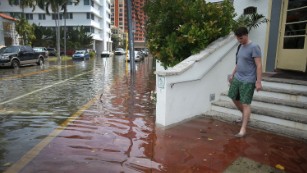
    Last month, a report from the global authority on climate science, the Intergovernmental Panel on Climate Change (IPCC), warned of the catastrophic consequences likely to result if humans cause global temperatures to rise more than 1.5 degrees Celsius above pre-industrial levels. The group also said that if we want to stay below the 1.5 degree limit, we'll need to use technologies that remove carbon dioxide (CO2) from the air.
      But the report noted that carbon removal at the scale that's likely required is "unproven and reliance on such technology is a major risk in the ability to limit warming to 1.5°C." In other words, don't solely bank on an unproven technology when your future is on the line.

      Burning fuel to clean the air

      Just how much CO2 we need to pull from the air depends on how much of that heat-trapping gas we keep pumping into the atmosphere.
      If we fail to make dramatic cuts -- which is how things stand with current global emissions pledges -- by the end of the century we might need to remove a total of around 30 times the CO2 that the world currently emits each year, according to the IPCC report.
      There are many methods we might use to remove CO2 from the air, from the low-tech -- simply planting more trees -- to the speculative -- adding iron to the oceans to speed the uptake of atmospheric CO2 by microscopic plant life.
      But one method that's got a lot of attention from IPCC scientists is known as Bioenergy with Carbon Capture and Storage, or BECCS. Essentially, it means growing bioenergy crops and then burning them at power stations to create energy, while capturing the CO2 that's emitted.
      When the bioenergy crops grow, they absorb carbon dioxide from the atmosphere. As long as the CO2 captured when they are burned is safely stored, the process is considered carbon negative.
      Of course, it's not quite that simple. Growing, collecting, transporting and processing the crops will have a carbon footprint, but advocates believe that if the process is well managed, BECCS can be an important tool in removing atmospheric CO2.
      Along with tree planting, BECCS is the CO2 removal method most used by the IPCC in its scenarios for limiting global warming.
      Niall MacDowell, who leads the Clean Fossil and Bioenergy Research Group at Imperial College, London, says: "BECCS tends to come out as the preferred technology in many of the scenarios because in addition to removing CO2 from the atmosphere, it also generates power and is therefore a more cost-effective way to deliver these negative emissions."

      The problem with BECCS

      Inevitably, BECCS has its drawbacks.
      As well as the difficulties in ensuring the bioenergy is carbon neutral, there is the problem of carbon capture.
      "There are very few examples of carbon capture and storage at large-scale power generating facilities that have come in on cost and work as expected," says Glen Peters, research director at the Center for International Climate Research, in Norway.
      "Large-scale" is the key adjective here for carbon capture, but even more so for bioenergy.
      In some emission scenarios, a land area bigger than India would be needed to grow the required bioenergy crops. That land might otherwise be used for forestry or to produce the food needed by a growing global population. Then there's the question of how much water is needed, and how much carbon is released by converting land for growing bioenergy crops.
      But MacDowell has studied the potential for BECCS to be rolled out at scale and believes it is possible, in theory at least.
      "My research indicates it can work but you have to be very careful to do it the right way," he says.
      "If one were not careful to astutely manage and optimize the entire supply chain, starting from land that's used for production of biomass right the way across the supply chain to harvesting and processing and final conversion to an energy product and effective sequestration of the CO2, then it might not work."
      But on top of the land needed to grow the crops, there is the land needed to store the CO2 indefinitely, and the infrastructure needed to move the CO2 there.

      Power station pilot

      So is BECCS a dead end? A dangerous distraction from the crucial business of cutting emissions? Some argue exactly that. Others see huge potential.
      There are some small BECCS projects already running, but this month, a facility in the north of England is set to become the first power station in the world to start piloting the technology.
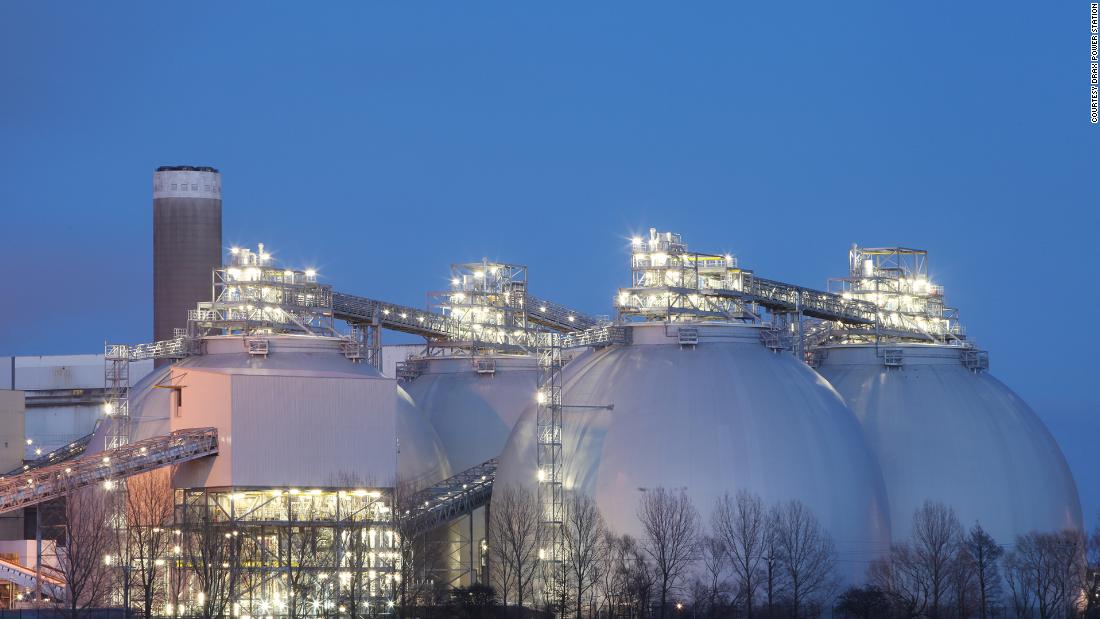
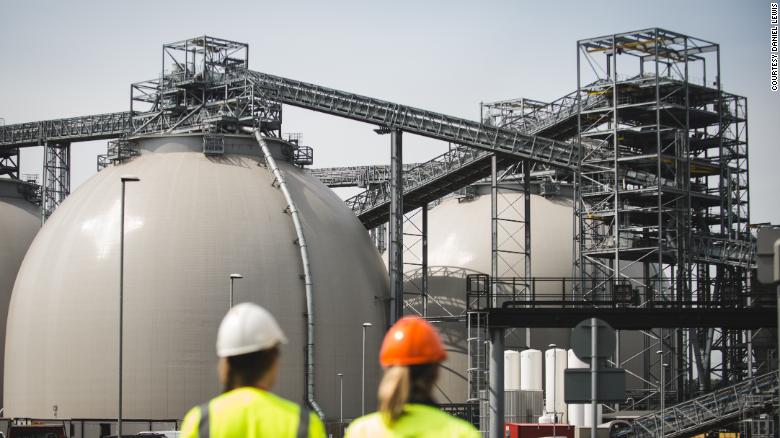
      Drax power station provides about 6% of the UK power supply. When it opened in the 1970s it burned only coal but these days, four of its six generators are powered solely by biomass.
      Biomass domes at Drax.
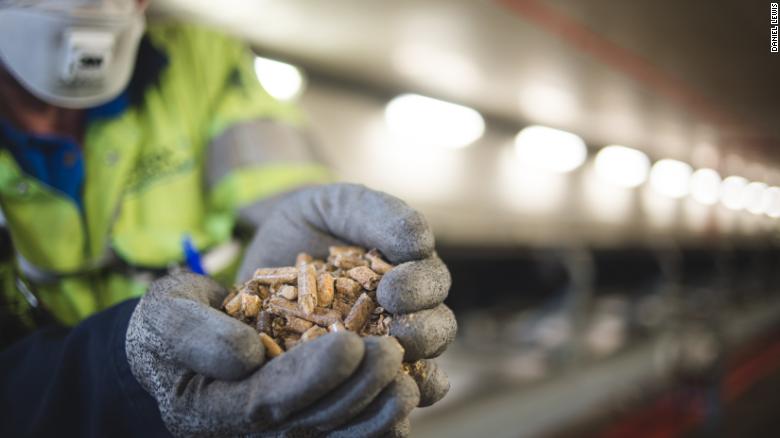
      It claims that by using sustainably sourced biomass from managed forests in the United States, it saves at least 80% of the CO2 it would have emitted by burning coal (the missing 20% is down to supply chain emissions).
      Remember, burning biomass still emits CO2 (actually, slightly more than coal, per unit of energy produced), but if Drax can capture that and either reuse or store it, then in theory, the process becomes carbon negative. Power generation that actually removes atmospheric CO2.
      Drax is working with a local company called C-Capture, which has developed a chemical to trap the CO2 from its biomass flue gases. The technology has been tested in the lab and the plan is to trial it at the power station.
      If Drax were to scale up the technology, Koss says a pipeline could be built to deliver the CO2 to disused North Sea oil or gas fields or aquifers, for long-term sequestration.
      The biomass pellets used at Drax
      If other power stations and heavy industries in the region were to also implement carbon capture, Koss says they could hook up to the same pipeline, driving down costs.
      But experts say that at the moment there's little economic incentive for large BECCS projects, and that governments should be providing more support.

      The risk we're taking

      Koss sees scope for some large-scale BECCS deployment around the world, but acknowledges there are limits to the amount of sustainable biomass that can be produced.
      If BECCS has a role to play in carbon removal, it will need to be alongside other methods.
      "The least helpful thing we can do at the moment is get captured by some sort of hype cycle where we get overly excited by one technology," says MacDowell.
      When it comes to fighting climate change, experts say the priority must still be to reduce emissions immediately.
        Peters warns of the dangers of us cutting emissions too slowly, in the hope that an unproven technology will one day make up for our inaction.
        "The IPCC scenarios (for reducing emissions) are based on the assumption that we have large-scale negative emissions," he says. "The risk there is that we're choosing a pathway today that depends on us having this technology in the future -- if we don't have this technology, future generations will pay the consequences."